
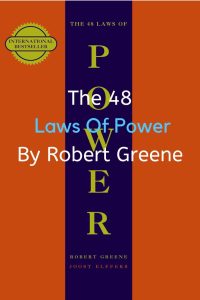
 Down below, are 48 Laws of Power, courtesy of the 1998 book, The 48 Laws of Power by Robert Greene, and nateliason.com/:
Law 1: Never outshine the boss;
Law 2: Never put too much trust in friends, learn how to use enemies;
Law 3: Conceal your intentions;
Law 4: Always say less than necessary;
Law 5: So much depends on reputation, guard your reputation;
Law 6: Court attention at all costs;
Law 7: Get others to do the work for you, but always take the credit;
RELATED: Cultural Intellectual sycophants
Law 8: Make other people come to you, use “enticements” if necessary;
Law 9: Win through your actions, never through argument;
Law 10: Avoid the unhappy or the “unlucky”;
Law 11: Learn to keep people dependent on you;
Law 12: Use selective honesty and generosity to disarm your victim;
Law 13: When asking for help, appeal to people’s self interest, not their mercy or gratitude;
RELATED: Polygamy versus Homosexuality
 Law 14: Pose as a friend, work as a spy;
Law 15: Be merciless with your enemies;
Law 16: Use absence to increase strength and honour;
Law 17: Keep others in suspense, cultivate an air of unpredictability;
Law 18: Do not build “walls” around yourself, isolation is dangerous;
Law 19: Know who you’re dealing with, do not offend the wrong person;
Law 20: Do not commit to anyone;
Law 21: Act like a fool to catch a fool, give the impression of being less intelligent and less knowledgeable than you actually are;
RELATED: Just Finish Your Business and Let Me Sleep
Law 22: Use the surrender tactic: transform weakness into power (People trying to make a show of their authority are easily deceived by the surrender tactic. It is always our first instinct to meet aggression with aggression. But the next time someone pushes you and you find yourself starting to react, try this: Do not resist or fight back, but yield, turn the other cheek, bend, then make your comeback move when your foe least expects it, when your foe has his or her guard down, when your foe is convinced that he or she had succeeded in “finishing” you);
Law 23: Save your energy for when it matters. For example, lions are skilful well coordinated hunters, though lions succeed in hunts 30% of time i.e. 70% of the time, lions “sleep hungry.” This is why lions take their time before “striking.” Lions observe prey for up to 30 minutes, looking for any “weak link” they can exploit e.g. a slightly injured animal in a herd of animals, or an animal in a herd of animals that appears “careless,” “careless” in terms of not paying keen attention to the surroundings. For example too, lions not succeeding in hunts 100% of the time, is a reason lions “confiscate meals” from hyenas. Hyenas too are skilful well coordinated hunters, and large packs of hyenas can overwhelm a pride of lions and “confiscate a meal” from a pride of lions. Both lions and hyenas are skilful well coordinated hunters, but are opportunistic too, “confiscate meals” from each other, and do not like each other. Lions kill hyenas when they can to “eliminate competition.” Rarely though, do lions eat the hyenas they kill. Hyenas on the other hand, eat the lions they kill i.e. to hyenas, lions are both “competition and food”;
RELATED: Pan-Africanism
 Law 24: Play the perfect courtier (i. Arrange to be noticed; ii. Alter your style and language according to the person you are dealing with; iii. Never criticise those above you, in a direct way; iv. Limit asking those above you for favours; v. Be self observant; vi. Master your emotions; Adjust to changing times);
Law 25: Re-create yourself (Be the master of your own image rather than letting others define it for you. The world wants to assign you a role in life. And once you accept that role you are doomed);
Law 26: Keep your hands clean (Conceal your mistakes, have a scapegoat around to blame);
Law 27: Play on people’s need to believe, when creating an ideology (Five rules of creating an ideology: i. Keep it vague, keep it simple; ii. Emphasise the visual and sensational over the intellectual; iii. Borrow forms of organised religion to structure your ideology; iv. Disguise your source of income; v. Create an “us vs. them” dynamic);
RELATED: Kenya to Hold The First Continental Commemoration of African Slave Trade and Colonialism in 2027
Law 28: Enter action with boldness (Boldness strikes fear, fear creates authority. Lions circle inattentive prey, Lions take advantage of prey not paying attention to the surroundings);
Law 29: Plan all the way to the end;
Law 30: Make your accomplishments appear effortless;
Law 31: Control the options, get others to play with the cards you deal (Give people a sense that things will fall apart “without you”);
Law 32: Play to people’s fantasies (People tend to disassociate their problems with their choices and actions, people tend to believe that “someone or something” is to blame for their problems e.g. society, their country, their government, the world, the gods);
Law 33: Find out the weaknesses of those around;
Law 34: Carry yourself with style, honour and dignity. Act like a King, or a Queen, to be treated like one;
Law 35: Master the art of timing;
Law 36: Disdain things you cannot have, ignoring them is the best revenge (You choose to let things bother you. You can just as easily choose not to notice the irritating offender, to consider the matter trivial and unworthy of your interest. That is the powerful move. The more you want something, the more you chase after it, the more it eludes you. The more interest you show, the more you repel the object of your desire. Uncontrollable desire makes you seem weak, unworthy, pathetic);
Law 37: Create spectacles (Create drama);
Law 38: Think as you like but behave like others;
RELATED: Manufacturing Witchcraft Scientifically
Law 39: Stir up waters to catch fish (Anger and emotion are counterproductive. Stay calm and objective. But if you can make your enemies angry while staying calm yourself, you gain a decided advantage);
Law 40: Despise the free lunch (The worth of money is not in its possession, but in its use);
Law 41: Avoid stepping into a great man’s shoes, avoid too, stepping into a great woman’s shoes;
Law 42: Strike the shepherd and the sheep will scatter;
Law 43: Work on the hearts and minds of others (The key to persuasion is compromise and flexibility);
Law 44: Disarm and infuriate with the mirror effect (When you mirror your enemies, doing exactly as they do, they cannot figure out your strategy. The Mirror Effect mocks and humiliates them, making them overreact);
RELATED: Is the proposed Dangote East Africa Refinery a pyramid scheme?
Law 45: Preach the need to change, but never reform too much at once (If change is necessary, make it feel like a gentle improvement on the past. Even while people understand the need for change, knowing how important it is for institutions and individuals to be occasionally renewed, they are also irritated and upset by changes that affect them personally);
Law 46: Never appear too perfect (It is smart to occasionally display defects, and admit to harmless vices, in order to deflect envy and appear more human and approachable. Do not try to help or do favours for those who envy you – they will think you are belittling them);
Law 47: Do not go past the mark you aimed for. In victory, know when to stop;
Law 48: Assume formlessness (By taking a shape, by having a visible plan, you open yourself to attack. Instead of taking a form for your enemy to grasp, keep yourself adaptable and on the move. Accept the fact that nothing is certain and no law is fixed. The best way to protect yourself is to be as fluid and formless like water. Never bet on stability or lasting order. Everything changes).
By Michael Mundia Kamau
kenyanhistory.home.blog