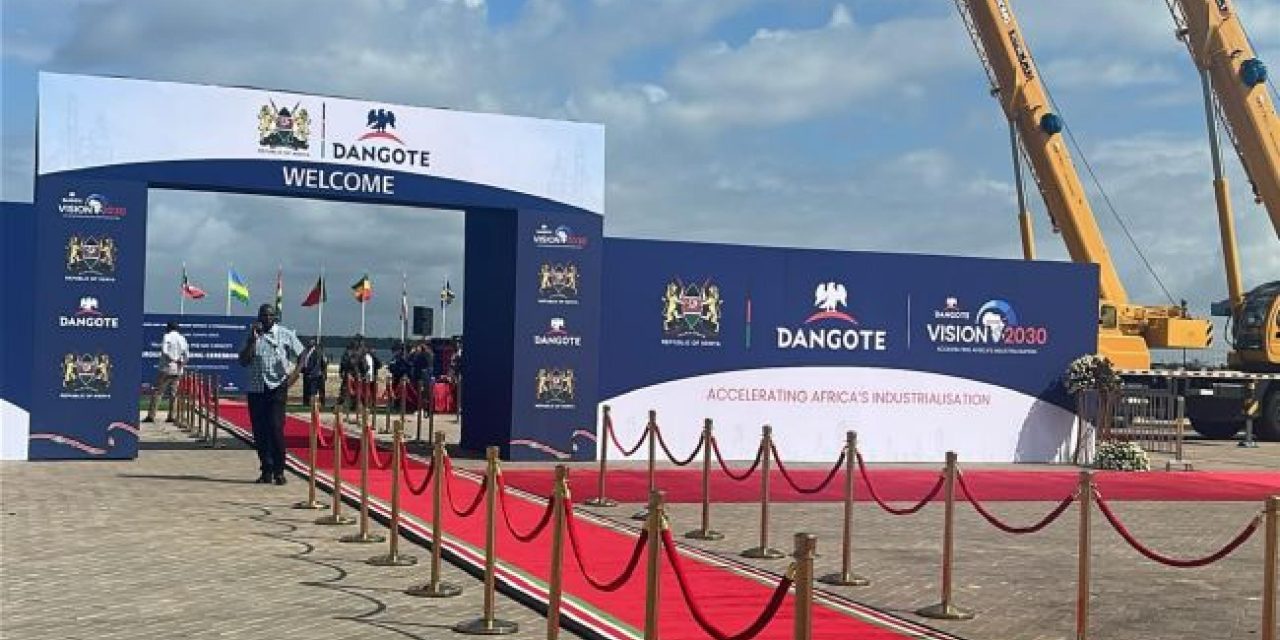
 The groundbreaking ceremony of the proposed Dangote East Africa Refinery was held in Lamu, Kenya, on 30th September 2026.
There are a number of unanswered questions regarding the proposed Dangote East Africa Refinery that is estimated to cost two trillion Kenya Shillings (approximately 15.5 billion US dollars) yet no detailed prospectus was published in advance as to how the US$15.5 billion to finance the project was going to be raised, who would underwrite the proposed project or who the guarantors of the proposed Dangote East Africa Refinery were.
Back in 1989, the then ruling party in Kenya, the Kenya African National Union (KANU), in partnership with Maxwell Communication Corporation (MCC) of the United Kingdom, proposed the construction of what was known as the Kenya Times Media Trust (KTMT) Complex, an ultramodern complex that would have comprised apartments, shopping malls, office buildings and two twin high rise skyscrapers of 60 floors each, at Uhuru Park in Nairobi.
RELATED:
The Whys of the Centre for African Aesthetics, The CAA
 The Kenya Parliament back, on behalf of the Government, stood as guarantors for the proposed Kenya Times Media Trust (KTMT) Complex, a decision that stirred controversy, because the proposed project was not a Kenya Government undertaking, but a joint undertaking between KANU and MCC of the United Kingdom. However, owing to legal challenges and finance constraints, the proposed KTMT Complex was never formally launched and was altogether abandoned in 1992. For three years though, between 1989 and 1992, Uhuru Park remained fenced off and out of bounds. Many of us back then thought that we would never see Uhuru Park again.
Another example is that of Madhupaper Kenya Limited, founded in 1976 by Kenyan entrepreneur, Samuel Kamau Macharia. This was a tissue paper manufacturing company. In 1982, Madhupaper secured a loan of one billion Kenya Shillings (US$39 million), to expand its operations in Kenya. It was a milestone back in Kenya in those days, quite the talk of town, for Madhupaper Kenya Limited, a privately owned company, to have secured borrowing of a billion Shillings from the World Bank. A billion Shillings in 1982 is the approximate equivalent of US$135 million in 2026, that Madhupaper secured from the World Bank back in 1982 pales in comparison to the cost of US$ 15.5 billion of the proposed Dangote East Africa Refinery.
RELATED: Decolonizing the Deification of History – Asante’s Question and the African Key
 How is Dangote East Africa Refinery going to be financed? Who are the shareholders in the proposed Dangote East Africa Refinery? are at least two questions that should have been clear to the public, well in advance of the groundbreaking ceremony on 30th September 2026. The proposed project bears the words East Africa in its operating name. Is this to mean that the shareholders of the proposed Dangote East Africa Refinery are the current member countries of the current East African Community? The current members of the current East Community are Kenya, the Democratic Republic of the Congo (DRC), Somalia, South Sudan, Uganda, Burundi, Tanzania and Rwanda.
The first East African Community of 1967 to 1977 of Kenya, Uganda and Tanzania, ended on a sour note, with Kenya deemed to have benefited unfairly from the sharing out of the assets of the first East African Community of 1967 to 1977.
For example:
1. East African Power & Lighting Company became a Kenyan asset, Kenya Power and Lighting Company;
2. East African Airways became a Kenyan asset, Kenya Airways;
3. East Africa Posts & Telecommunications Corporation became a Kenyan asset, Kenya Posts & Telecommunications Corporation. The Kenya Posts & Telecommunications Corporation was split into three in 2000; Telkom Kenya, Postal Corporation of Kenya and Communications Authority of Kenya. It was the Kenya Posts & Telecommunications Corporation that founded Safaricom in 2000. Safaricom is the largest company in East and Central Africa;
4. East African Railways and Harbours became Kenyan assets, Kenya Railways and the Kenya Ports Authority, and both Kenya Railways and the Kenya Ports Authority were major assets and major employers in the Kenya of the 1980s and the 1990s.
Kenya Railways, Kenya Ports Authority and the other corporations mentioned here above, were key Kenyan blue-chip companies of the 1980s and the 1990s and Uganda and Tanzania would therefore be justified in feeling that major assets of the first East African Community of 1967 and 1977 were unfairly allocated to Kenya.
RELATED: Ignoring Culture Undermines Development
A project of any magnitude, not least a project estimated to cost US$15.5 billion, should bear no assumptions, and in the absence of clarity, the proposed Dangote East Africa Refinery is rife with assumptions. For example, if the shareholders of the proposed Dangote East Africa Refinery are the member countries of the current East African Community, and if the proposed Dangote East Africa Refinery were to be become as successful as the East African Power & Lighting Company, East African Airways, East Africa Posts & Telecommunications Corporation and East African Railways and Harbours, would the assets of the proposed Dangote East Africa Refinery accrue disproportionately to Kenya, as happened after 1977, should the current East African Community of Kenya, the Democratic Republic of the Congo (DRC), Somalia, South Sudan, Uganda, Burundi, Tanzania and Rwanda also breakup at some point in the future?
Dangote East Africa Refinery is an initiative of the Dangote Group of Lagos in Nigeria that also owns the Dangote Petroleum Refinery of Lagos. There is already a proposed Initial Public Offering (IPO) of shares in the Dangote Petroleum Refinery of Lagos, Nigeria, at the Nairobi Securities Exchange, scheduled to run for one week from 5th October 2026 to 13th October 2026. The IPO is being defined as Global Depositary Receipts (GDRs) in Dangote Petroleum Refinery of Nigeria.
What Global Depositary Receipts (GDRs) are and how they work, has not been explained to the Kenyan public, or the broader East African Community public, something that should have been done well in advance of both 30th September 2026 and 5th October 2026.
Privately owned companies usually issue IPOs of shares when they want to finance undertakings, such as the expansion of operations. The share price offer of the IPO of Dangote Petroleum Refinery of Lagos, Nigeria, of 5th October 2026 to 13th October 2026 at the Nairobi Securities Exchange is proposed at 49 Kenya Shillings per share, with a minimum purchase of ten shares. This is an attractive offer in the sense that Kenyans are being asked to invest a minimum of 490 Kenya Shillings in the Dangote Petroleum Refinery of Nigeria.
RELATED: Why people marry
However, it is difficult not to make a direct link between the groundbreaking ceremony of Dangote East Africa Refinery of 30th September 2026, and the IPO of shares in the Dangote Petroleum Refinery of Nigeria of 5th to 13th October 2026, in the sense that the proposed IPO of shares in the Dangote Petroleum Refinery appears targeted to raise funds for the construction of the proposed Dangote East Africa Refinery. It appears that the Dangote Group of Lagos, Nigeria, does not have ready finance for the construction of the proposed Dangote East Africa Refinery. Why are Kenyans being asked to participate in the IPO of shares in a company that is yet to prove itself?
For example, the IPO in the Kenya Electricity Generating Company (KENGEN), was massively oversubscribed in 2006. KENGEN is a household name in Kenya, KENGEN has a track record in Kenya, KENGEN have proved themselves in Kenya, Kenyans had confidence in KENGEN, confidence that was not disappointed, because KENGEN shares appreciated significantly in value at the Nairobi Securities Exchange (then known as the Nairobi Stock Exchange), after they started trading at the Nairobi Securities Exchange/Nairobi Stock Exchange, after the IPO.
There was a stock market boom at the Nairobi Securities Exchange/Nairobi Stock Exchange in 2003 soon after the National Rainbow Coalition (NARC) came to power in Kenya following Kenya’s General Elections of 27th December 2002. NARC defeated the Kenya African National Union (KANU) at Kenya’s General Elections of 27th December 2002, and there was a widespread feeling of hope, confidence and euphoria across Kenya, that the National Rainbow Coalition (NARC) would elevate Kenya to advancement and heightened development, which is what fueled the stock market boom at the Nairobi Securities Exchange/Nairobi Stock Exchange of the year 2003.
Many Kenyans made money at the Nairobi Securities Exchange/Nairobi Stock Exchange from the appreciation of share prices during the stock market boom of 2003. Some bought land, some bought cars, some bought both, and some even took holidays abroad. The share price appreciation of KENGEN of 2006 was similar to the stock market boom of 2003, though on a lower scale. Even then, there are many Kenyans who still have fond memories of the KENGEN Initial Public Offering (IPO) of 2006, there are still many Kenyans who benefited from the KENGEN Initial Public Offering (IPO) of 2006.
Kenyans knew KENGEN, and Kenyans still know KENGEN. Kenyans do not however know the Dangote Group of Lagos, Nigeria, nor the Dangote Petroleum Refinery of Lagos, Nigeria, yet Kenyans are being asked to invest a minimum of 490 Kenyan Shillings in the Dangote Petroleum Refinery of Lagos, Nigeria. If the Dangote Group of Lagos, Nigeria, does not have the two trillion Kenya Shillings (US $ 15.5 billion) to finance the proposed Dangote East Africa Refinery, they should not turn to Kenyans for financing through what looks like a suspicious Initial Public Offering (IPO) of shares, they should consult the likes of Samuel Kamau Macharia (S.K. Macharia), now 84 years old, and find out how Madhupaper Kenya Limited, a privately owned company, was able to secure borrowing of one billion Kenya Shillings (US $ 39 million), from the World Bank, back in 1982.
And there are options. If we in Kenya feel that an oil refinery is an appropriate investment for the present and the future, then the Kenya Petroleum Refineries Limited (KPRL) in Mombasa, Kenya, should be revived, expanded and modernised for the purposes of refining crude oil. The Kenya Petroleum Refineries Limited (KPRL) refined crude oil for 50 years from 1963 to 2013. What is the Dangote Group offering that the Kenya Petroleum Refineries Limited (KPRL) cannot? Let us also remember that no one has more experience in oil refining than the United States of America (USA). The best example of this is the Standard Oil Company founded in the year 1870 by John D. Rockefeller and his brother William Rockefeller. At it’s peak, the Standard Oil Company controlled about 90% of oil refining in the USA. At it’s peak too, the Standard Oil Company was the largest and most powerful company in the world, and in the year 1916, one of the co-founders of the Standard Oil Company, John D. Rockefeller, became the world’s first billionaire. Nelson Rockefeller, a grandson of John D. Rockefeller, was US Vice President from 1974 to 1977.
However, since the heydays of the Standard Oil Company, the USA has scaled back on oil refineries and has closed down oil refineries in the USA such as Valero Benicia in California, LyondellBasell Houston in Texas and Phillips 66 Los Angeles in California. The USA still has major domestic oil refineries, but even then, the USA still imports refined oil from Canada, Turkey, South Korea, Norway and Mexico. The USA is an experienced player in the oil industry globally, but even then, the USA still has major challenges of it’s own when it comes to oil refining, and the oil industry in general. For example, the USA experienced a major spike in oil prices in September 2026, reminiscent of the major oil price hikes of 2008 under then US President, George W. Bush, when oil prices at one point hit US $ 147.50 per barrel. The major spike in oil prices in the USA of September 2026, are also reminiscent of major oil price spikes of 1979 brought about by the Iranian Revolution of 1979, during the US presidency of Jimmy Carter, and the major oil price spikes of 1973 brought about by the Yom Kippur War, during the US presidency of Richard Nixon. The major oil price spikes of 1973 also extended here to us in Kenya. The major spike in oil prices in the USA of September 2026, look like they will also extend here to Kenya during the 15th October 2026 to 14th November 2026 price reviews of Kenya’s Energy and Petroleum Regulatory Authority (EPRA). So there should be nothing celebratory about the proposed Dangote East Africa Refinery, because the USA has at least 156 years of experience in the line of oil refining, and yet the USA possibly has even more challenges in the line of oil refining, than any other country in the world.
RELATED: The two fiercest African watchdogs
We Kenyans continue to be misguided, misdirected, misused, misadvised and misinformed, and this is unfortunate. For example, back in 1996, there was a fundraising for the revival of Kenya’s Kisumu Molasses Factory. Many Kenyans were asked to donate five Kenya Shillings each towards the revival of Kisumu Molasses Factory, and many Kenyans voluntarily came forward and did just that. However, the Kisumu Molasses Factory was not revived and neither have monies raised from the fundraisers, ever been accounted for. The 1996 fundraising for the revival of the Kisumu Molasses Factory was led by Raila Odinga, Prime Minister of Kenya from 2008 to 2013. In 1996 though, Raila Odinga was Member of Parliament for Langata Constituency, Kenya. Also, Kenneth Matiba was a presidential candidate at Kenya’s General Elections of 29th December 1992. Kenneth Matiba came second. In 1993, Kenneth Matiba’s Alliance Group of Hotels & Associated Companies (that included the Hillcrest Group of Schools), came under the risk of auction over an outstanding loan of 300 million Kenya Shillings owed back then to Barclays Bank of Kenya (today Absa Bank Kenya). Kenyans were asked to make donations to save Kenneth Matiba’s Alliance Group of Hotels & Associated Companies (that included the Hillcrest Group of Schools), from auction, at an account that was opened back then at Barclays Bank of Kenya, Queensway House Branch, Nairobi, Kenya. There were long queues of Kenyans at Barclays Bank of Kenya, Queensway House Branch, Nairobi, Kenya, back then in 1993, Kenyans who came forward in big numbers to save Kenneth Matiba’s Alliance Group of Hotels & Associated Companies from auction. However, the monies raised back in 1993 to avert the auction of Kenneth Matiba’s Alliance Group of Hotels & Associated Companies, have never been accounted for. Will the proposed Dangote East Africa Refinery be a repeat of the Kisumu Molasses Factory saga of 1996, and a repeat too of the Alliance Group of Hotels & Associated Companies saga of 1993?
In addition, Kenyans lost savings in Kenyan banks and financial institutions that collapsed in the 1980s and the 1990s, such as Continental Bank, Rural-Urban Credit Finance, Trade Bank and Trust Bank. Will the proposed Dangote East Africa Refinery be a repeat of the 1980s and the 1990s, as relates to the fall of Kenyan banks and Kenyan financial institutions back then? Kenyans too lost big sums of in Kenyan pyramid schemes of the 2000s, such as the Development Entrepreneurship and Community Initiative (DECI). During campaigns for Kenya’s General Elections of 27th December 2007, pledges and premises were made to ensure that victims of Kenya’s collapsed pyramid schemes of the 2000s, were compensated. After close to 20 years now, no such compensations have been made. Will the proposed Dangote East Africa Refinery be a repeat of the collapsed Kenyan pyramid schemes of the 2000s?
By Michael Mundia Kamau,
kenyanhistory.home.blog