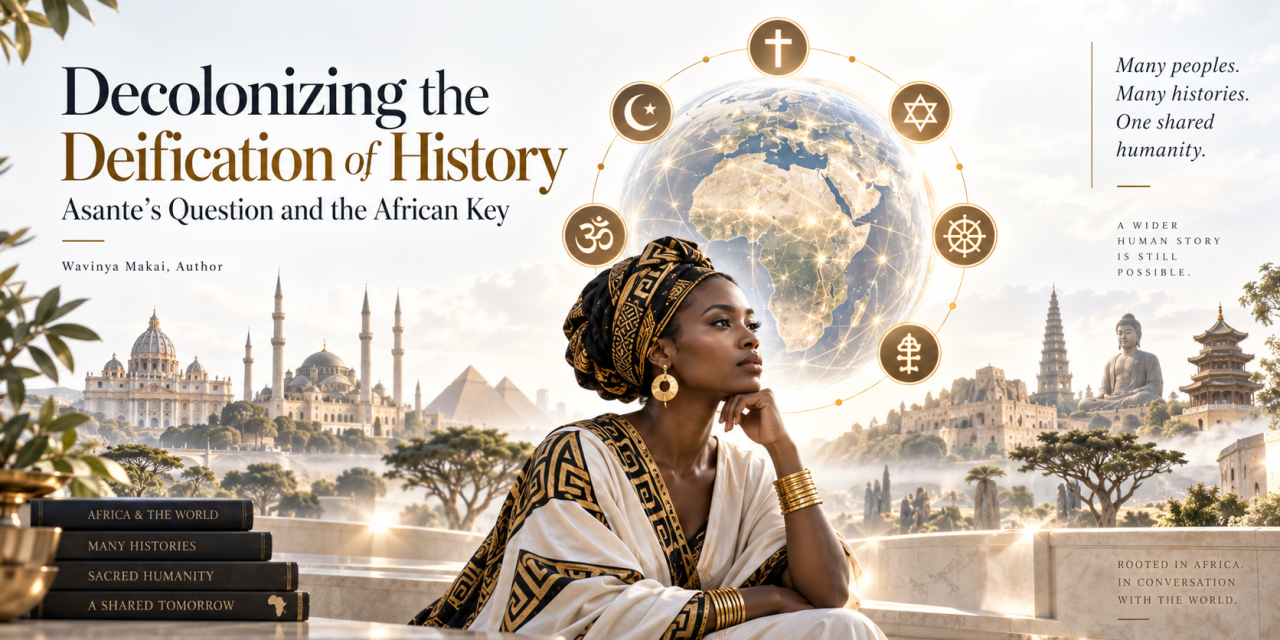
 There is a point at which history ceases to be encountered as history and begins to acquire the authority of the sacred. The experiences of a particular people become sacred memory; their geography becomes sacred geography; their historical personalities become universal reference points; their languages acquire spiritual authority; and their struggles, victories, migrations and revelations gradually enter the consciousness of peoples far removed from the historical world in which those experiences first arose. With sufficient time and institutional power, the particularity of that history begins to disappear. What originated within one community comes to appear as though it belongs naturally to humanity as a whole. It is this movement from historical particularity to apparent universality that makes Molefi Kete Asante’s argument in Afrocentricity: The Theory of Social Change so intellectually provocative.
RELATED: Ignoring Culture Undermines Development
Published by Amulefi Publishing Company in Buffalo in 1980, Afrocentricity was conceived as a theory of social change grounded in African agency and centredness. Asante was concerned with the psychological, cultural and political consequences of Africans being displaced from the centre of their own historical experience. The book examines history, identity, politics, economics, education and religion through a common question: what happens when African people cease to function as subjects within their own reality and instead interpret themselves from locations created by other peoples? Google Books describes the book’s central concern as the insistence that Africans be approached as subjects rather than objects.
It is within this larger argument that Asante reflects on Islam under the leadership of Elijah Muhammad and describes it as having functioned, at an important historical moment, as a transitional Black nationalist movement. Asante’s concern was that when the political and nationalist dimensions of that movement receded and the emphasis became predominantly religious and cultural, an important question of African location emerged. He then offers the striking proposition that “all religions rise out of the deification of someone’s nationalism” and urges his reader to recognise in this relationship a key to African victory (Asante 1980, 5). The wording and page reference are corroborated in later scholarship examining Afrocentricity and African religious location.
The importance of the statement lies beyond any particular judgement about Islam. Asante is raising a much larger civilizational question. Every major religious tradition enters human history through particular peoples, languages, landscapes, memories and historical circumstances. Judaism developed through the historical experience and sacred traditions of ancient peoples of the Near East. Christianity arose from within that Jewish world before developing through the Mediterranean and subsequently through multiple African, European, Asian and global civilizations. Islam emerged in seventh-century Arabia and expanded into a vast and internally diverse civilization stretching across Africa, Asia and Europe. Buddhist traditions arose within ancient South Asia and travelled extensively across Asia and eventually the world, while the traditions now grouped under Hinduism emerged through enormously diverse histories on the Indian subcontinent. African religious traditions likewise emerged through particular communities, ancestral relationships, cosmologies, landscapes and systems of meaning. Religion, whatever claims it subsequently makes about universal truth, always enters human consciousness somewhere.
RELATED: The African and witchcraft
To recognise this historical situatedness is not to diminish religious belief. It is to restore history to religion. The intellectual problem emerges when the historical particularity of a sacred tradition becomes invisible and the history through which it arose begins to operate as though it were history without location. Particular sacred landscapes then become global sacred landscapes. Particular languages become languages through which millions encounter revelation. Particular personalities become familiar across continents, while the ancestors and philosophers of other societies become obscure even to their descendants. Particular calendars organise global time, particular civilizational conflicts become universally remembered moral events, and particular historical experiences increasingly provide the conceptual vocabulary through which distant peoples explain existence itself.
This is where Asante’s idea of deification becomes analytically useful. Deification need not be interpreted as the literal transformation of every historical personality into a god. Such an interpretation would be historically and theologically inaccurate. Islam explicitly rejects the deification of Muhammad; Judaism does not worship Moses; Buddhist traditions contain multiple understandings of the Buddha; Hindu traditions encompass an extraordinary diversity of theological positions; and African spiritual systems themselves cannot be collapsed into a single conception of divinity. Asante’s deeper intellectual provocation concerns what happens when an entire historical universe acquires sacred authority and subsequently travels beyond the people among whom that universe was first formed.
The history itself becomes elevated. Certain memories become canonical. Certain places become sacred. Certain ancestors and prophets become universally known. Certain civilizational languages acquire extraordinary symbolic status. Particular historical stories begin to structure understandings of morality, salvation, suffering, destiny, sacrifice, good and evil across communities that did not participate in the original historical events. As sacred history expands, the historical pathway through which it acquired universality often disappears from view. What remains is universality without visible history.
RELATED: African values for Posterity
For Africa, this question possesses unusual significance because the globalization of religion intersected with slavery, colonial conquest, missionary expansion, formal education and the systematic reorganisation of African knowledge. Colonialism did not restrict itself to conquering territory. It rearranged memory. It altered which histories were taught, which personalities were celebrated, which civilizations were presented as foundational and which peoples were positioned as peripheral. Generations of Africans entered classrooms in which the major achievements of humanity appeared repeatedly to originate somewhere outside Africa. Philosophy was frequently narrated from Greece onward. Modern political thought was overwhelmingly located in Europe. Scientific advancement appeared through European personalities. Great religious histories centred distant geographies. Africa repeatedly entered the story as colony, convert, recipient, underdeveloped territory or problem awaiting external intervention.
The consequences of such historical displacement are psychological as well as political. A child who continuously encounters the foundations of civilization, knowledge, sanctity and human achievement somewhere outside the world from which that child emerges gradually learns something deeper than the facts written in textbooks. The child learns where the centre is. When greatness consistently possesses another geography, another genealogy and another historical vocabulary, Africa becomes psychologically peripheral even to Africans themselves. This is precisely the problem of location that Afrocentricity seeks to address.
Asante defines Afrocentricity through the concepts of agency, location, place, centredness and subjecthood. In his later formulation for the Center for Intercultural Dialogue, he explains that Afrocentricity privileges the centricity of African people within their own historical experiences and seeks to redirect discourse on African phenomena away from frameworks that render Africans marginal or passive. Crucially, he also describes Afrocentricity as an open intellectual system rather than a religion or fixed belief structure. This distinction is essential because the purpose of Afrocentricity is not to construct another closed orthodoxy. It is to recover the African subject.
RELATED: Marriage will remain eternal institution
It is from this intellectual position that Asante calls us toward what this article names the decolonization of the deification of history. The phrase should be understood as a formulation of the task contained within Asante’s argument rather than as a verbatim expression from Afrocentricity. If history has become deified through the elevation of particular civilizational experiences into seemingly universal accounts of humanity, decolonization requires us to make those histories visible again as histories. We must recover the peoples behind the universal, the geography behind the sacred, the political journey behind the canon and the historical conditions behind what later appears timeless.
This requires us to distinguish carefully between universality and universalization. Universality asks whether a truth, moral insight or spiritual idea possesses significance beyond the society in which it originated. Universalization asks how a particular idea, history or cultural system acquired the institutional reach to present itself as universally authoritative. These are different intellectual questions. A tradition might genuinely speak to human experiences across many cultures while still carrying the imprint of the people, landscape and historical circumstances through which it developed. Recognising its particular history does not invalidate its spiritual or philosophical significance; it makes our understanding of that significance historically mature.
The African problem begins when universalization demands displacement. Africans should be able to encounter Christianity without becoming historically European, Islam without becoming historically Arab, Buddhism without becoming historically Asian, or any other global tradition without experiencing alienation from Africa. The question is not whether Africans should participate in traditions originating elsewhere. Human beings have always exchanged ideas, philosophies, rituals and systems of knowledge. The more serious question is whether participation requires the African to vacate the African historical centre.
This question becomes especially illuminating when we consider Africa’s own long and complicated relationship with global religions. Christianity possesses ancient African histories that predate European colonialism by centuries, particularly in Egypt, Ethiopia and Nubia. Islam became deeply embedded within African intellectual life through centres stretching from Cairo and Fez to Timbuktu, Sokoto, the Swahili coast and numerous other regions. Africans did not simply receive these religious traditions passively. They interpreted, translated, institutionalised and transformed them. Any serious decolonial scholarship must acknowledge this African agency rather than producing another simplistic narrative in which Africa exists only as the victim of external ideas.
Yet agency does not eliminate the question of location. An African Christian may possess a sophisticated knowledge of European Christian history while knowing little about the African histories of Christianity. An African Muslim may know the sacred geography and intellectual history of Arabia while possessing limited knowledge of the long traditions of African Islamic scholarship. An African university graduate may discuss European philosophers in detail yet struggle to name African thinkers who confronted equally profound questions of being, justice, society and human destiny. The central contradiction is not knowledge of other peoples. Knowledge of other civilizations enriches human consciousness. The contradiction lies in knowing others while remaining historically estranged from oneself.
RELATED: Cultural Intellectual sycophants
This is why Asante’s argument should not be read as a project of replacing one civilizational absolutism with another. Afrocentricity is not intellectually strongest when understood as the demand that Africa become the new universal centre. It becomes most powerful when understood as a theory of plural centredness. Asante’s later explanation is explicit on this point. Afrocentricity seeks what he describes as a mature relationship with other cultures, without attempting to impose itself upon them or secure advantage through domination. By becoming centred within their own cultures, Africans enter multicultural discourse as legitimate partners rather than as marginal participants dependent upon somebody else’s categories.
This is perhaps the most important African key contained within Asante’s work. The answer to Eurocentrism is not a reversal in which Africans now demand that every other people see humanity from Africa. The answer is the destruction of the hierarchy that permits one centre to disguise itself as the only centre. Africa must recover its location, Asia must retain its locations, Indigenous peoples must possess their historical centres, Europe must be understood as one great historical experience among others, and humanity must become intelligible as a conversation between civilizations rather than a hierarchy arranged around one sacred history.
The implications extend far beyond religion. Historical centrality affects education, language, aesthetics, development, economics and political imagination. A people who consistently experience themselves as late arrivals in civilization become vulnerable to importing solutions without interrogating the historical assumptions embedded within them. They begin to consume other societies’ interpretations of progress, intelligence, beauty, governance and economic development as if such interpretations emerged outside history. Decolonizing the deification of history consequently becomes part of a larger task of recovering the capacity to ask who produced a concept, under what historical conditions, from which social location, and in whose interests that concept acquired universal authority.
RELATED: Why Pre-Colonial Africa Had No Prisons
Cheikh Anta Diop’s scholarship becomes significant within this project because he challenged the exclusion of Africa from the history of civilization and insisted that the reconstruction of African history was indispensable to African cultural regeneration (Diop 1974). Frantz Fanon revealed how colonial power entered the psyche and shaped the colonized person’s relationship with language, recognition and selfhood (Fanon 2008 [1952]). Kwame Nkrumah demonstrated that formal political independence could coexist with deeper structures of economic and political dependency (Nkrumah 1965). Walter Rodney placed contemporary African underdevelopment within the history of European expansion and capitalist extraction rather than treating Africa’s condition as an isolated internal failure (Rodney 1972). Amílcar Cabral insisted on the importance of culture within national liberation and recognised that the struggle against colonial domination necessarily involved the restoration of historical personality (Cabral 1973).
These thinkers should not themselves be deified. That would reproduce the intellectual problem under discussion. The importance of recovering African intellectual ancestors lies precisely in the possibility of entering into argument with them. A living intellectual tradition is not a collection of saints whose words cannot be challenged. It is an inheritance of questions, disagreements, conceptual breakthroughs, failures, warnings and unfinished possibilities. Africans should read Nkrumah critically, debate Fanon, question Asante, extend Diop, revisit Cabral and examine Rodney against contemporary evidence. Intellectual heritage becomes liberating when it restores thought, not obedience.
This is where the ideology of heritage becomes essential. A people who do not know their intellectual ancestors repeatedly begin their political and philosophical conversations from zero. They encounter crises that earlier generations diagnosed, develop vocabularies for problems already extensively theorised and import conceptual solutions because they are unaware of indigenous or historically African traditions of thought. Heritage is not valuable because everything ancestral deserves preservation. Heritage is valuable because a people who possess memory are able to decide consciously what to preserve, what to reject, what to transform and what to carry forward.
RELATED: Why Africa Needs Social Revolution
The decolonization of the deification of history must consequently involve the recovery of historical plurality. Humanity contains many sacred landscapes, many philosophical traditions, many stories of origin, many systems of ethics, many conceptions of personhood and many ways of confronting suffering, death, community and transcendence. The existence of this plurality does not require us to conclude that every claim is identical or that truth itself is meaningless. It requires us to abandon the historical arrogance through which one people’s path to truth becomes the compulsory historical biography of everyone else.
Asante’s Afrocentricity provides an especially useful framework here because centredness does not require isolation. The centred African is not the African who refuses to learn from the world. The centred African is the African who encounters the world without disappearing within it. Such a person may learn Arabic, Hebrew, Greek, Latin, Sanskrit, Chinese or any other language without imagining that intelligence lives only within those languages. Such a person may encounter Jerusalem, Mecca, Rome, India or any other sacred geography while remaining conscious that Africa itself contains landscapes saturated with human memory, philosophy and spiritual meaning. The purpose of centredness is not withdrawal. It is the restoration of a location from which genuine encounter becomes possible.
The future of decolonization therefore cannot be constructed through another politics of erasure. Africa does not become free by making Europe invisible, nor does African consciousness require contempt for Arabia, India, Asia or any other civilization. The task is more ambitious. We must dismantle the architecture through which visibility was distributed hierarchically in the first place. The goal is a human history spacious enough for multiple civilizations to appear as makers of knowledge, bearers of memory and subjects of their own narratives.
RELATED: Is science New to the African?
Asante’s question ultimately returns us to power. Who possesses the capacity to transform a particular historical experience into a universal category? Who controls the institutions through which historical memory is transmitted? Which stories receive schools, publishing houses, universities, religious institutions, media systems, museums and global languages through which they reproduce themselves across generations? Why are some ancestral traditions called mythology while others are called theology? Why are some intellectual traditions treated as philosophy while others are placed under anthropology or folklore? These classifications reveal that the struggle over history is simultaneously a struggle over authority.
To decolonize the deification of history, then, is to recover consciousness of the historical processes through which universality has been constructed. It is to see religion historically without stripping it of meaning, to see civilization comparatively without creating hierarchies of human worth, and to restore Africans to the centre of African experience without demanding that everyone else surrender their own centres. It is to understand that plurality is not fragmentation. A genuinely plural humanity is composed of peoples capable of knowing themselves deeply enough to encounter one another without domination or disappearance.
This is the African key within Asante’s provocation. Africa does not need to withdraw from humanity in order to recover itself. Africa must recover itself in order to enter humanity fully. The work begins when Africans are able to recognise other peoples’ prophets while remembering their own ancestors, to study other civilizations without abandoning African history, to participate in global religions without becoming historically homeless, and to engage universal questions without assuming that universal answers must always originate elsewhere. Asante’s intellectual challenge leads us toward a world in which no people need to disappear for another people’s history to possess meaning. Decolonizing the deification of history is, at its deepest level, the recovery of a plural human story in which Africa returns not as an appendix, recipient or object, but as one of humanity’s conscious historical subjects.
RELATED: Kenya to Hold The First Continental Commemoration of African Slave Trade and Colonialism in 2027
References
Asante, Molefi Kete. 1980. Afrocentricity: The Theory of Social Change. Buffalo, NY: Amulefi Publishing Company. The passage concerning religion, nationalism and Elijah Muhammad appears on p. 5. The publication details of the original edition are confirmed by WorldCat and Google Books.
Asante, Molefi Kete. 1987. The Afrocentric Idea. Philadelphia: Temple University Press.
Asante, Molefi Kete. 2014. “Afrocentricity: Toward a New Understanding of African Thought in the World.” In The Global Intercultural Communication Reader, 2nd ed., edited by Molefi Kete Asante, Yoshitaka Miike, and Jing Yin, 101–110. New York: Routledge. Asante’s concise description of Afrocentricity as centred, agentic, open to argument, and oriented toward mature intercultural relations is also reproduced by the Center for Intercultural Dialogue.
Cabral, Amílcar. 1973. Return to the Source: Selected Speeches of Amílcar Cabral. Edited by Africa Information Service. New York: Monthly Review Press.
Diop, Cheikh Anta. 1974. The African Origin of Civilization: Myth or Reality. Translated by Mercer Cook. New York: Lawrence Hill.
Fanon, Frantz. 2008 [1952]. Black Skin, White Masks. Translated by Richard Philcox. New York: Grove Press.
Fanon, Frantz. 2004 [1961]. The Wretched of the Earth. Translated by Richard Philcox. New York: Grove Press.
Nkrumah, Kwame. 1965. Neo-Colonialism: The Last Stage of Imperialism. London: Thomas Nelson & Sons.
Rodney, Walter. 1972. How Europe Underdeveloped Africa. London: Bogle-L’Ouverture Publications.
Schreiber, Lisa. 2000. “Overcoming Methodological Elitism: Afrocentrism as a Prototypical Paradigm for Intercultural Research.” International Journal of Intercultural Relations 24 (5): 651–671. The article discusses cultural centredness, paradigmatic pluralism, liberation and agency as important dimensions of the Afrocentric paradigm.
Written by Wavinya Makai